
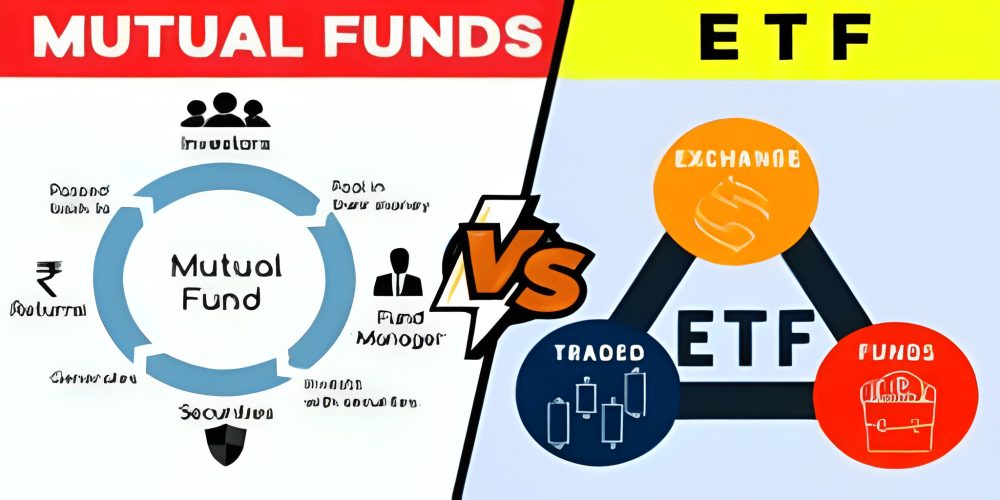
Understanding the difference between ETF and mutual fund is essential for anyone looking to invest smartly in today’s financial markets. Both Exchange-Traded Funds (ETFs) and mutual funds are popular investment options that allow individuals to diversify their portfolios without having to pick individual stocks. However, despite their similarities, they differ in structure, trading style, cost, and tax efficiency.
In this detailed guide, we will break down the difference between ETF and mutual fund in simple terms, helping beginners and experienced investors make informed decisions.
What is an ETF?
An Exchange-Traded Fund (ETF) is a type of investment fund that trades on stock exchanges, much like individual stocks. ETFs typically track an index, sector, commodity, or asset class.
For example, an ETF may track indices like Nifty 50 or Sensex, giving investors exposure to a broad range of stocks in one investment.
Key Features of ETFs
- Traded on stock exchanges in real-time
- Prices fluctuate throughout the day
- Usually passively managed
- Lower expense ratios
- High transparency
What is a Mutual Fund?
A mutual fund pools money from multiple investors and invests it in a diversified portfolio of stocks, bonds, or other securities. These funds are managed by professional fund managers.
Unlike ETFs, mutual funds are not traded on stock exchanges. Instead, they are bought and sold at the Net Asset Value (NAV), which is calculated at the end of each trading day.
Key Features of Mutual Funds
- Professionally managed
- Can be actively or passively managed
- Priced once per day (NAV)
- Available through fund houses
- Suitable for long-term investors
Difference Between ETF and Mutual Fund
Let’s explore the core difference between ETF and mutual fund based on key parameters.
1. Trading Mechanism
The most significant difference between ETF and mutual fund lies in how they are traded.
- ETFs are bought and sold on stock exchanges throughout the trading day.
- Mutual funds are purchased or redeemed at the end-of-day NAV.
This means ETF investors can react to market movements instantly, while mutual fund investors cannot.
2. Pricing
Another important difference between ETF and mutual fund is pricing.
- ETF prices change continuously during market hours.
- Mutual funds have a fixed price calculated once daily.
This makes ETFs more suitable for active traders, while mutual funds are better for long-term investors.
3. Management Style
- ETFs are usually passively managed and track an index.
- Mutual funds can be actively managed, where fund managers aim to outperform the market.
Active management in mutual funds often leads to higher costs.
4. Expense Ratio
Cost plays a major role in understanding the difference between ETF and mutual fund.
- ETFs generally have lower expense ratios because they are passively managed.
- Mutual funds, especially active ones, have higher fees due to professional management.
Lower costs can significantly impact long-term returns.
5. Minimum Investment
- ETFs require you to buy at least one unit, similar to a stock.
- Mutual funds often have minimum investment requirements (like ₹500 for SIPs).
This makes mutual funds more accessible for beginners with smaller capital.
6. Liquidity
Liquidity is another crucial difference between ETF and mutual fund.
- ETFs offer high liquidity as they are traded on exchanges.
- Mutual funds provide liquidity but only at end-of-day NAV.
7. Tax Efficiency
- ETFs are generally more tax-efficient due to lower turnover.
- Mutual funds may generate more capital gains due to frequent buying and selling by fund managers.
8. Transparency
- ETFs disclose their holdings daily.
- Mutual funds usually disclose holdings monthly or quarterly.
This makes ETFs more transparent for investors.
9. Investment Strategy
- ETFs are ideal for passive investors who want to mirror the market.
- Mutual funds are suitable for those seeking active management and potentially higher returns.
Similarities Between ETF and Mutual Fund
While discussing the difference between ETF and mutual fund, it is also important to understand their similarities.
- Both offer diversification
- Both are regulated investment products
- Both can invest in stocks, bonds, or commodities
- Both reduce risk compared to individual stock picking
Pros and Cons of ETFs
Advantages
- Lower costs
- Real-time trading
- Tax efficiency
- High transparency
Disadvantages
- Requires a demat account
- Brokerage charges may apply
- Not ideal for SIP investing (though possible)
Pros and Cons of Mutual Funds
Advantages
- Professional management
- Easy SIP investment
- No need for a demat account
- Suitable for beginners
Disadvantages
- Higher expense ratios
- Less transparency
- No intraday trading
Which is Better: ETF or Mutual Fund?
There is no one-size-fits-all answer to the difference between ETF and mutual fund when choosing the better option. It depends on your investment goals.
Choose ETFs if:
- You want low-cost investing
- You prefer passive strategies
- You are comfortable with stock market trading
Choose Mutual Funds if:
- You want professional fund management
- You prefer SIP investments
- You are a long-term investor
ETF vs Mutual Fund: A Practical Example
Let’s say you want to invest in the Indian stock market.
- With an ETF, you can buy a Nifty 50 ETF and track the index in real-time.
- With a mutual fund, you can invest in an actively managed large-cap fund that aims to beat the index.
This example clearly highlights the difference between ETF and mutual fund in terms of strategy and flexibility.
Who Should Invest in ETFs?
ETFs are best suited for:
- Experienced investors
- Traders looking for flexibility
- Cost-conscious investors
- Those who prefer passive investing
Who Should Invest in Mutual Funds?
Mutual funds are ideal for:
- Beginners
- Long-term investors
- Individuals investing through SIPs
- Those who prefer expert management
Common Mistakes to Avoid
When understanding the difference between ETF and mutual fund, avoid these mistakes:
- Ignoring expense ratios
- Not considering investment goals
- Overtrading ETFs
- Choosing funds based only on past returns
Future of ETFs and Mutual Funds in India
Both ETFs and mutual funds are growing rapidly in India. With increasing financial awareness and digital platforms, investors now have more options than ever.
- ETFs are gaining popularity due to low costs
- Mutual funds remain dominant due to SIP culture
Understanding the difference between ETF and mutual fund will help investors benefit from both.
Conclusion
The difference between ETF and mutual fund lies mainly in trading style, cost, management, and flexibility. ETFs offer real-time trading and low costs, making them ideal for passive investors. Mutual funds, on the other hand, provide professional management and ease of investment, making them suitable for beginners and long-term investors.
Choosing between the two depends on your financial goals, risk tolerance, and investment strategy. In many cases, a balanced portfolio that includes both ETFs and mutual funds can provide the best results.
FAQs: Difference Between ETF and Mutual Fund
1. What is the main difference between ETF and mutual fund?
The main difference between ETF and mutual fund is that ETFs trade on stock exchanges in real-time, while mutual funds are priced once daily at NAV.
2. Are ETFs safer than mutual funds?
Both ETFs and mutual funds carry market risk. Safety depends on the underlying assets, not the structure.
3. Which is cheaper: ETF or mutual fund?
ETFs are generally cheaper due to lower expense ratios compared to actively managed mutual funds.
4. Can beginners invest in ETFs?
Yes, but beginners may find mutual funds easier due to SIP options and no need for a demat account.
5. Do ETFs pay dividends?
Yes, some ETFs pay dividends depending on the underlying assets.
6. Can I do SIP in ETFs?
Yes, but it is not as straightforward as mutual fund SIPs.
7. Which is better for long-term investment?
Both can be good. Mutual funds are easier for long-term SIP investing, while ETFs are better for low-cost passive investing.
8. Are ETFs tax-free?
No, ETFs are subject to capital gains tax similar to mutual funds.
9. Do mutual funds guarantee returns?
No, mutual funds do not guarantee returns as they are market-linked investments.
10. Should I invest in both ETFs and mutual funds?
Yes, combining both can help diversify your portfolio and balance cost with active management benefits.





















Leave A Comment
0 Comment