
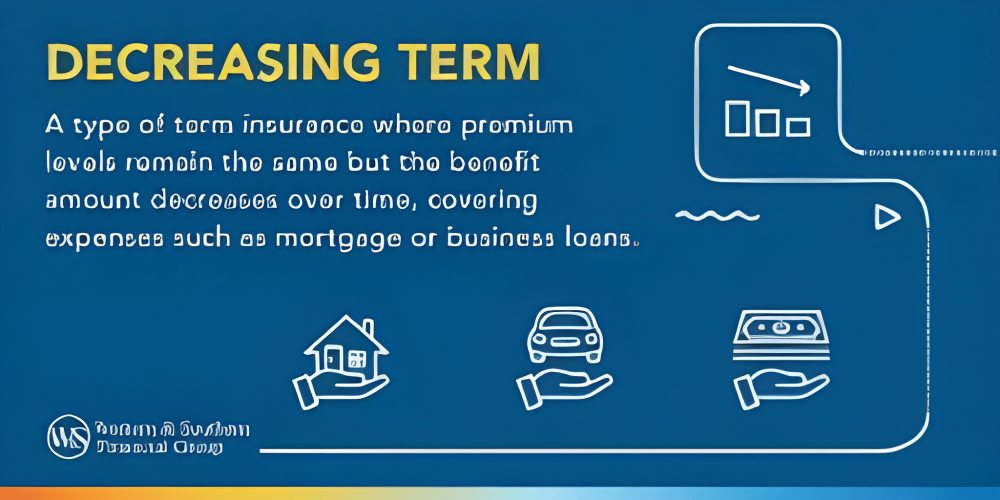
When most people think about life insurance, they usually imagine a plan that pays out a fixed amount to beneficiaries if the insured passes away. But there is a specific type of life insurance that is designed to match debts that reduce over time, like mortgages or business loans. This is called Decreasing Term Insurance.
This guide explains everything you need to know about decreasing term insurance, how it works, who should consider it, its benefits and limitations, and how it compares to other life insurance options. By the end, you will have a clear understanding of whether this type of policy is right for your situation.
What Is Decreasing Term Insurance
Decreasing term insurance is a type of term life insurance where the sum assured reduces at a steady pace during the policy term. The reduction usually follows the schedule of the loan you wish to cover, such as a mortgage or business loan.
The basic idea is simple: you start with a certain coverage amount, and as you repay your loan, the insurance coverage decreases. This matches your liability over time. If the insured person dies during the policy term, the insurer pays out the current sum assured to the nominee, who can use it to pay off the remaining loan balance.
This type of insurance is popular among homeowners, business owners, and anyone who wants to secure a loan balance against an unexpected death.
How Decreasing Term Insurance Works
Here’s how decreasing term insurance generally works.
- You decide how much coverage you need. Typically, this matches the amount of your loan or debt.
- You select the term of the policy. This should match the length of the loan repayment period.
- Your insurance company calculates the premium, which is usually fixed throughout the policy term.
- Every year (or month, depending on the policy), the sum assured reduces according to a pre-set schedule that usually mirrors the outstanding balance of your loan.
- If you pass away during the policy term, your beneficiary receives the current sum assured. This amount helps clear any remaining loan.
- If you survive the entire term, the policy ends without any payout.
The policy’s decreasing nature makes it an efficient way to cover a debt without paying for unnecessary extra coverage.
Who Should Consider Decreasing Term Insurance
Decreasing term insurance is not for everyone, but it makes sense for people in certain situations. You should consider this type of policy if:
- You have a home loan and want to make sure your family can pay it off if something happens to you.
- You have a large loan such as a business loan, personal loan, or car loan that would burden your family if you pass away unexpectedly.
- You are looking for a cost-effective way to cover a specific debt only, rather than leaving a large lump sum for general family expenses.
- You are confident that your liabilities will reduce steadily over time.
If you have financial dependents who rely on your income for general living expenses, you may need an additional level term plan or whole life policy for broader protection.
Benefits of Decreasing Term Insurance
There are several clear advantages to choosing decreasing term insurance for debt protection.
Affordable Premiums
Premiums for decreasing term insurance are usually lower than level term policies because the risk for the insurance company decreases each year. The payout amount reduces over time, which means less risk to the insurer.
Matches Your Loan Balance
The policy is designed to decrease along with your loan balance. This means you do not overpay for coverage you do not need.
Peace of Mind
Knowing that your family will not be left with unpaid debts brings peace of mind. It ensures they will not have to sell assets or face financial stress to clear your loans.
Simple to Understand
The concept is straightforward and easy to manage. You know upfront how the sum assured will decrease and for how long.
Limitations of Decreasing Term Insurance
While decreasing term insurance has clear benefits, there are some drawbacks to keep in mind.
No Payout at Maturity
Like all term insurance, decreasing term insurance does not pay out anything if you outlive the policy term.
Decreasing Benefit
Unlike a level term policy, the payout reduces every year. If your family needs additional money for other expenses, the lower payout may not be sufficient.
Less Flexibility
Once you choose the decreasing schedule, it cannot usually be changed. If you repay your loan earlier than expected or take on a new loan, you may need to buy a separate policy for new liabilities.
Not Suitable for All Needs
Decreasing term insurance is perfect for covering debts but not suitable if your goal is wealth transfer, estate planning, or long-term family income replacement.
Level Term Insurance vs Decreasing Term Insurance
People often compare decreasing term insurance with level term insurance. Here are some key differences in words, no table format.
Coverage Amount
In level term insurance, the sum assured remains constant throughout the policy term. In decreasing term insurance, the sum assured reduces gradually.
Premiums
Premiums for level term insurance are higher because the payout amount stays the same throughout the term. Premiums for decreasing term insurance are lower since the coverage amount drops over time.
Purpose
Level term insurance is suitable for providing general financial security to family members, paying for education, or other living costs. Decreasing term insurance is specifically designed to cover debts that decrease over time.
Decreasing Term Insurance vs Mortgage Insurance
Many people confuse decreasing term insurance with mortgage insurance. Although both protect against unpaid home loans, there are differences.
In decreasing term insurance, you own the policy, and your beneficiary (like your spouse or children) receives the payout. They can use the money however they want, which usually includes paying off the mortgage.
In mortgage insurance, the lender owns the policy and is the beneficiary. If you pass away, the insurer pays the lender directly to clear the loan. Your family has no control over how the payout is used.
Decreasing term insurance gives your family more flexibility and control compared to lender-owned mortgage insurance.
How to Buy Decreasing Term Insurance
Buying decreasing term insurance is similar to purchasing any other life insurance policy. Here’s how you can do it.
Assess Your Debt
Identify the debts you want to cover. Note their amounts, interest rates, and repayment terms.
Choose the Right Policy Term
Select a policy term that matches the repayment period of your loan. For example, if your mortgage runs for 20 years, buy a 20-year decreasing term plan.
Calculate the Initial Sum Assured
Your sum assured should ideally be the same as the current outstanding balance of your loan.
Compare Plans
Check offers from different insurance providers. Look at premium rates, how the sum assured decreases, and any additional features like riders.
Check for Riders
Some insurers offer add-on riders like accidental death benefit or critical illness cover. Consider if these add value for you.
Complete Application and Medical Tests
Fill out the application truthfully and undergo any medical examinations if required. Full disclosure helps avoid claim rejections later.
Keep Beneficiaries Informed
After buying the policy, make sure your beneficiaries know about it, where the documents are kept, and how to file a claim if needed.
What Happens If You Pay Off the Loan Early
One common question is about what happens if you repay your loan before the policy term ends.
Most decreasing term insurance policies follow a fixed decreasing schedule. This means that even if you pay off your loan early, your coverage will keep decreasing as originally planned until the term ends. You can choose to cancel the policy early, but you typically will not receive any refund of premiums.
If you plan to repay your loan early, you might consider a level term plan instead, or look for a flexible decreasing plan if available.
Can You Combine Decreasing Term Insurance With Other Policies
Many people combine decreasing term insurance with a level term or whole life policy. This way, you get the best of both options.
The decreasing term policy covers your debts at a lower cost.
The level term or whole life policy provides additional funds for your family’s daily living expenses, education, or future goals.
Combining both gives your family complete financial security: your debts are covered, and they also have extra money for other needs.
How Claims Work
If the policyholder passes away during the term, the beneficiary should contact the insurance company to start the claims process.
The insurer will ask for the policy document, a filled claim form, the death certificate, identity proof of the nominee, and sometimes loan documents to confirm the liability.
Once verified, the insurer will pay the claim amount equal to the sum assured at the time of death. The family can then use the payout to clear the debt or for any other purpose.
Common Mistakes to Avoid
Here are a few mistakes to watch out for when buying decreasing term insurance.
Choosing the Wrong Term
Always match the policy term with the loan term. If your loan is for 20 years, do not buy a 10-year decreasing term plan.
Underinsuring
Make sure the initial sum assured is enough to cover your current debt. Underestimating it can leave your family with unpaid balances.
Not Comparing Plans
Different insurers offer varying rates and decreasing schedules. Always compare at least three to five plans before deciding.
Not Informing Family
Your family should know that this policy exists and how to claim it if something happens to you.
Real-Life Example
Consider Emma, who takes a mortgage loan of two hundred thousand dollars for 25 years. She buys a 25-year decreasing term insurance plan with an initial sum assured of two hundred thousand dollars. Each year, the coverage decreases roughly in line with her mortgage balance.
If Emma passes away in year ten, when her outstanding mortgage is one hundred and thirty thousand dollars, the insurance will pay the current sum assured, which matches the remaining debt. Her family can use this money to clear the mortgage, keeping the house debt-free.
If she survives the full term, the policy expires with no payout, but by then, she has already repaid the mortgage.
Trends in Decreasing Term Insurance
Over the years, decreasing term insurance has become more popular as more people take long-term loans for homes, cars, and businesses.
More insurers now offer online buying options, making it easier to compare and purchase policies without paperwork.
Some insurers now offer more flexible plans where you can choose the rate at which the sum assured decreases, or add riders for better protection.
Digital claim processes have also made it simpler for families to claim the payout when needed.
Frequently Asked Questions (FAQs)
Is decreasing term insurance better than level term insurance
Not necessarily better or worse, just different. Decreasing term insurance is good for covering debts that decrease over time. Level term insurance is better for providing a fixed lump sum for any purpose.
Do I get my money back at the end of the term
No. Like most term insurance policies, there is no maturity benefit. If you survive the term, the policy expires without a payout.
Can I buy decreasing term insurance without a loan
Yes, but it may not make sense. Decreasing term insurance is designed to match liabilities that reduce. If you have no loan, a level term or whole life plan is usually better.
What happens if I switch lenders
If you switch mortgage lenders, your decreasing term policy is not affected. Unlike lender-owned mortgage insurance, you own the policy. It continues to protect you no matter who holds your loan.
Can I increase or decrease the sum assured later
Usually, the decreasing schedule is fixed when you buy the policy. If you want more flexibility, look for a plan that allows some adjustment or buy a level term plan for additional coverage.
Conclusion
Decreasing term insurance is a simple and cost-effective way to make sure your family is not burdened by unpaid debts if something unexpected happens. It aligns protection with your actual loan balance, so you do not pay for unnecessary extra coverage.
While it is not a replacement for broader life insurance, it is an excellent tool for debt protection. Combine it with a level term or whole life plan for full financial security for your loved ones.





















Leave A Comment
0 Comment